Financial Statements · 16 October 2026 · 8 min read
How to Build Small Business Financial Statements Without an Accountant
The three statements you actually need, a simple chart of accounts, and a full worked example for one month — about 30 minutes of work each month.

Many small business owners treat financial statements as an accountant's job. In practice you need three things each month, and all three can be built from the daily records you already keep.
1. The three statements you actually need
- This month's profit and loss — what came in, what went out, and what is left.
- Cash flow — where the money actually moved. Profit on paper does not guarantee you can pay wages on the first of the month.
- A list of debts, receivables and stock — the three items that most often explain why "profit" does not match your bank balance.
A full balance sheet, depreciation and a statement of changes in equity can follow later. For day-to-day decisions, these three are enough.
2. Ground rules before you start
- Business money and personal money must never share one pocket. This is the most common reason a busy business looks like it is losing money.
- Record every day, not once a month from memory.
- Close the books once a month on a fixed date — for example the first day of the month for the month before.
3. A simple chart of accounts (twelve lines is plenty)
You do not need many categories. The list below covers almost every transaction in a small business:
| Type | Account |
|---|---|
| Revenue | Sales |
| Cost of goods | COGS (raw materials and goods bought for resale) |
| Expenses | Wages, rent, utilities, transport, marketing, supplies, other |
| Assets | Cash, Bank, Inventory |
If you are unsure where something belongs, ask: "when this goes up, does my sales figure go up, or is it a cost?" When still unsure, park it in other and tidy it up at month end.
4. The daily record: five columns
Date · description · category · money in · money out. For example:
| Date | Description | Category | In | Out |
|---|---|---|---|---|
| 01/10 | Daily cash sales | Sales | 1,250,000 | — |
| 01/10 | Raw materials purchase | COGS | — | 480,000 |
| 02/10 | Shop rent, October | Rent | — | 1,500,000 |
Three rows like this are already enough to build the reports later — as long as you write them consistently every day.
5. A worked profit and loss for one month
Say October looks like this:
| Line | Amount (Rp) |
|---|---|
| Sales | 42,500,000 |
| Cost of goods sold | (17,000,000) |
| Gross profit | 25,500,000 (60.0% of sales) |
| Rent | (1,500,000) |
| Wages | (6,000,000) |
| Utilities | (850,000) |
| Transport | (400,000) |
| Other | (250,000) |
| Total operating costs | (9,000,000) |
| Net profit | 16,500,000 (38.8% of sales) |
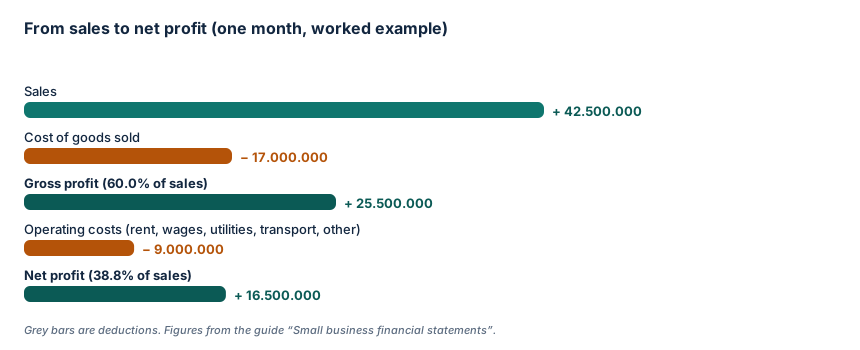
The numbers above are made up as an example, but the way you read them is real:
- Gross margin of 60% means that of every Rp100 of sales, Rp60 is left after materials. The rest covers operating costs.
- Net margin of 38.8% is what the business actually keeps, before tax and before you take money out for yourself.
- When the gross margin is already thin (below 30%, say), adding discounts only speeds up the loss. What needs fixing first is the selling price or the purchase price of materials.
6. Four mistakes that happen again and again
- Treating the bank balance as profit. The balance can be high because a customer paid a deposit, and low because you just bought three months of stock.
- Mixed personal money. Household spending gets recorded as "other expenses", and the month looks like a loss.
- Recording only a daily total. Without a description per transaction you will never see which category is growing.
- Starting only when a tax deadline arrives. Records rebuilt from memory are almost always wrong on cost of goods and stock.
7. Closing the books in 30 minutes a month
- Count the physical cash and match it to your records.
- Reconcile the bank statement against your cash book.
- Value the closing stock.
- Build the profit and loss and cash flow from your daily records.
- Write down next month's decisions: what to reprice, what to cut.
If your daily records are in order, steps 1 to 4 take about half an hour.
8. If you want to move faster
Our Small Business Bookkeeping Kit already includes a cash book, a chart of accounts, monthly summaries and a profit and loss statement that does the arithmetic for you — you just replace the example numbers with your own.
The kit for this topic
Small Business Bookkeeping Kit
Rp149.000 (≈ USD 8)
One spreadsheet for a small business: journal, ledger, balance sheet, profit and loss, and cash flow — all linked.