Cash Flow & Forecasting · 16 October 2026 · 6 min read
Separating Business and Personal Money: A Practical Guide
Seven steps to separate business cash from household money, how to set an owner's salary, and how much is safe to take out each month.

The business looks busy, the account keeps growing, yet there is nothing left when you count the cash in hand. Almost always there is one cause: business money and household money use the same pocket.
1. Why this matters
- Profit becomes fiction. Money you spend on the household gets recorded as a "cost", so a business that earns looks like it loses.
- No reserve. Business money is treated as personal money, so there is never a fund for stock, equipment or a slow month.
- Tax becomes a mess. Gross turnover is your sales, not what is left after you have spent some of it personally.
2. Seven steps to separate them
- Open one account used only for the business. It does not have to be a company account; an ordinary personal account works, as long as it is business-only.
- Send all receipts there. Including QRIS payments and marketplace payouts.
- Pay business costs from it. Materials, wages, rent, business utilities — not household shopping.
- If you must use business money personally, record it as an owner's drawing, not as a business expense.
- Set a fixed owner's salary and transfer it to your personal account on the same date each month. Whatever is left stays in the business account.
- Set aside tax money monthly, however small, so it does not pile up at year end.
- Set aside a reserve of at least 10% of net profit for equipment and slow months.
3. How much is safe to take each month?
Using the profit and loss from the statements guide: net profit for October is Rp16,500,000.
| Line | Example (Rp) | How it is set |
|---|---|---|
| Net profit | 16,500,000 | from this month's profit and loss |
| Owner's salary | (5,000,000) | a fixed amount, unchanged month to month |
| Business reserve | (1,650,000) | 10% of net profit |
| Left in the business account | 9,850,000 | for stock, equipment and slow months |
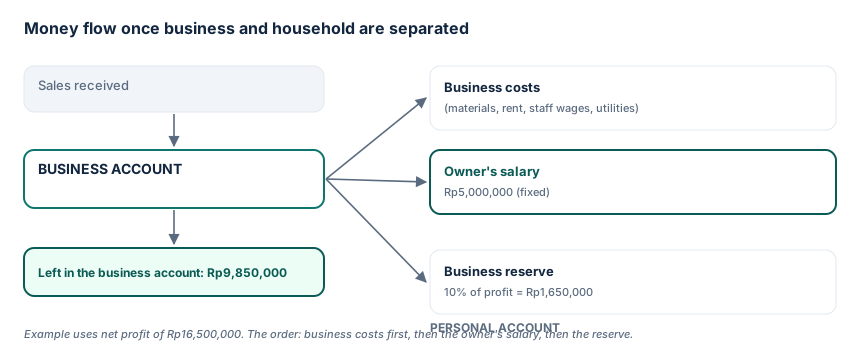
The order matters: the owner's salary comes after business costs are paid, never before.
4. Tax: what applies now
For individual small business owners in Indonesia, the final income tax rate is 0.5% of gross turnover as long as turnover stays below Rp4.8 billion a year. A further concession applies: the first Rp500 million of turnover in a year is not taxed for individual taxpayers.
Example: annual turnover of Rp600,000,000. Only the excess is taxed: Rp100,000,000 × 0.5% = Rp500,000 a year, about Rp41,700 a month. With annual turnover of Rp480,000,000, no final income tax is due at all.
The legal basis is Government Regulation No. 55 of 2022, amended with effect from 22 April 2026 by Government Regulation No. 20 of 2026. The important change: the 0.5% rate now applies only to individuals, single-member companies and cooperatives — CVs and regular limited companies can no longer use it. For individuals and single-member companies there is no longer an expiry date on using the rate.
Important note: tax rules change and every business is different. The figures above are a general illustration, not tax advice. Check the latest rules on the official Directorate General of Taxes website or ask a tax adviser before deciding.
5. Signs you have separated them properly
- You can state last month's profit without opening your personal account.
- The owner's salary leaves on the same date each month for the same amount.
- A balance remains in the business account after salary and tax are set aside.
- When the business needs money suddenly, you do not borrow from the household budget.
Our Cash Flow Forecast Kit helps with the last step: seeing where cash gets tight over the coming weeks, so personal drawings do not disrupt business payments.
The kit for this topic
Cash Flow & Forecast Kit
Rp99.000 (≈ USD 6)
See money in, money out, and what your bank balance looks like over the next twelve weeks.