COGS, Margin & Pricing · 16 October 2026 · 7 min read
How to Calculate Unit Cost and Set Your Selling Price
Working out the cost of one unit or one serving — labour and direct overhead included — then setting the price from the margin you want.

Pricing by "see what competitors charge and go a thousand lower" is the fastest route to working hard with no profit. Your price should start from unit cost: what one unit actually costs you.
1. What belongs in unit cost and what usually gets left out
Unit cost is not only materials. It has three layers:
- Direct materials — what physically goes into the product.
- Direct labour — the people who make that product. Divide the monthly wage by the number of units produced.
- Other direct costs — packaging, machine power, gas, water, delivery per order.
What does not belong here: rent, internet, admin salaries, advertising. Those are operating costs, used in the calculation further down, not in the cost of one unit.
2. Worked example: one cup of milk coffee
| Component | Calculation | Rp per cup |
|---|---|---|
| Coffee, 18 grams | 18/1,000 × Rp180,000 per kg | 3,240 |
| Milk, 150 ml | 150/1,000 × Rp22,000 per litre | 3,300 |
| Cup, lid, napkin | per unit | 1,100 |
| Sugar and straw | per unit | 250 |
| Total materials | 7,890 | |
| Direct labour | Rp2,500,000 ÷ 1,200 cups a month | 2,083 |
| Other direct costs | Rp180,000 ÷ 1,200 cups (machine power, water) | 150 |
| Unit cost per cup | 10,123 |
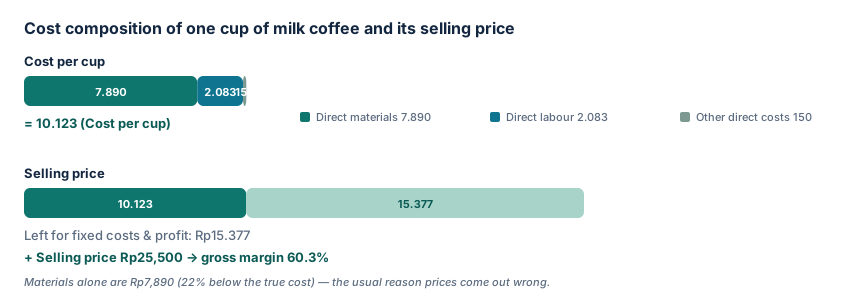
Notice: leave labour out and the cost looks like only Rp7,890 — about 22% cheaper than reality. Prices built on that figure make you feel profitable when you are not.
3. Setting the selling price
Two approaches work well together:
a. From a markup
If you want a gross profit near 60%, the markup is about 2.5 times cost: Rp10,123 × 2.5 = Rp25,308, rounded to Rp25,500.
b. From the margin you want (more precise)
The formula is: price = unit cost ÷ (1 − margin you want).
Target margin 60%: Rp10,123 ÷ 0.4 = Rp25,308, rounded to Rp25,500.
At a price of Rp25,500:
- Gross margin = (25,500 − 10,123) ÷ 25,500 = 60.3%
- Materials alone = 7,890 ÷ 25,500 = 30.9% of the selling price — for food and beverage businesses that sits inside the range commonly regarded as healthy (usually kept around 30–35%). Once it passes 40%, check your portions and purchase prices.
- Contribution per cup towards fixed costs = Rp15,377
4. How many cups do you need to sell?
Say fixed costs are Rp12,000,000 a month (rent, fixed wages, internet, shop utilities).
Break-even = Rp12,000,000 ÷ Rp15,377 = 781 cups a month, about 26 cups a day (over 30 days).
That figure is far more useful than hoping it gets busy: you know when you start making money, and you know how much you need to lift if last month sold only 700 cups.
5. Four common mistakes
- Calculating unit cost from materials only.
- Not updating material prices. Coffee, cooking oil and flour move; unit cost built on last year's prices makes the margin look better than it is.
- Discounting without knowing your unit cost. A 20% discount on Rp25,500 brings the price to Rp20,400, leaving Rp10,277 — still above cost, but barely anything towards fixed costs.
- Using one average cost for every product. Each item has its own unit cost; never price a single item from an average.
6. Update it every quarter
Keep the ingredients, latest prices and portion sizes in one sheet. Repeat the exercise every quarter or whenever a key ingredient moves. Ten minutes a quarter is far cheaper than a year of selling at the wrong price.
Our Pricing & Margin Calculator contains all of these formulas: enter your costs and portions and it returns the recommended price and break-even point.
The kit for this topic
Pricing & Margin Calculator
Rp79.000 (≈ USD 4)
Work out unit cost, set your margin, and find the break-even price before you quote.